This paper analyses policy-practice gap in disability inclusion in social protection and livelihood programmes to assuage the unrelenting discrepancies between policy intentions and the real policy implementation results. Although more countries have now adopted rights based models and a national policy commitment towards international standards, such as the UN Convention on the Rights of Persons with Disabilities (CRPD) and the Sustainable Development Goals, persons with disabilities remain heavily marginalized in the provision of social protection and economic opportunities. Using secondary data analysis and document review, based on the Walt and Gilson Policy Triangle and Implementation Gap Analysis models, the study finds that the policy contents, institutional coordination, accessibility provisions, and monitoring systems have significant weaknesses. The results indicate that disability allowances have relatively a higher coverage, but other wider social support and livelihood initiatives have minimal coverage, which points to systemic factors like lack of infrastructures, poor disability disaggregated monitoring and limited capacity of good governance. Lack of implementation causes inequitable access, low enrolment and service needs. The research highlights the significance of closing the policy-practice gap by enhancing the quality of programme design, imposing the standards of accessibility, promoting participatory policy development with the involvement of the disabled persons organisations, and developing effective evaluation systems. These are some steps that can assist the conversion of formal policy commitments into actual inclusion outputs, in favoring equitable social protection and livelihood opportunities to persons with disabilities.
Disability inclusion refers to the establishment of societies in which everyone can equally participate, irrespective of their mobility, communication style, thought processes, or interaction. (Wood, 2006). The inclusion of disability is significant to the whole world since inequalities in health-care services provided to individuals with disabilities are experienced universally, mostly owing to inaccessible amenities and insufficient knowledge among the providers of health services. The UN Flagship Report on Disability and Development (2018) also notes that the issue of attitudinal barrier and stigma greatly limits access to health services by persons with disabilities(Meeks et al., 2020). There is a vicious cycle between disability and poverty in which either could result in the other; such as in the U.S. 23% of of working-age individuals with disabilities lived in poverty versus 9% without disabilities(Palmer, 2011). Approximately 1.3 billion individuals in the world experience disabilities, and they are more prone to mortality, more diseases, and great obstructions in health systems, including inaccessible healthcare, high expenditures, and discrimination(Gréaux et al., 2023). Inclusion of disability is important to sustainable development as more than 1 billion individuals in the world are living with disabilities and approximately 80 percent of these individuals are in developing nations where poverty and development issues are the most acute(Brolan, 2016).
A disability affects about 15 per cent of the world population and a majority of them reside in the low- and middle-income nations where multidimensional poverty is rampant. Disabilities increase deprivation of people in terms of health care, education, employment, and social participation, and hence they are more susceptible to multidimensional poverty(Pinilla-Roncancio et al., 2020).Disability worsens poverty as individuals with disabilities are twice/ thrice more prone to unemployment and also have additional health-care and living expenses, decreasing household earnings and amplifying financial susceptibility(Pinilla-Roncancio, 2015). There is a two-way correlation between disability and poverty, where poverty may cause disability and vice versa and approximately 15-20 percent of poor people in developing countries are people with disabilities(Banks et al., 2017). The disabled encounter a great deal of social inequalities and more than 650 million individuals globally encounter hindrances in education, labor and social engagements owing to handicap(Barnes & Mercer, 2005).
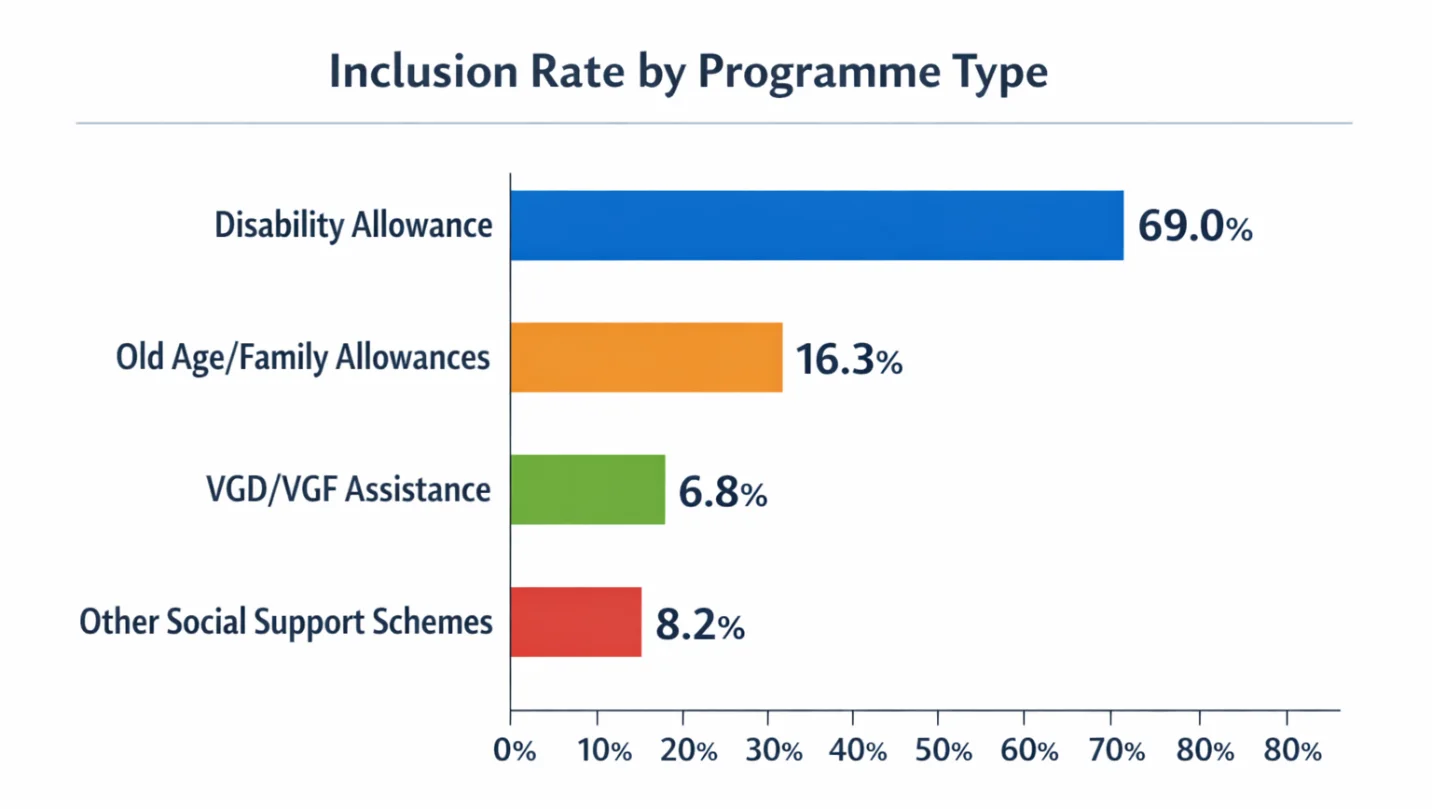
Social protection programmes are policies and interventions (including social assistance, insurance, and welfare schemes) which are used to secure minimum livelihood and protect the subjects against risks such as unemployment, illness, or economic shocks. They alleviate poverty through giving people income support and increasing access to services, enabling poor households to sustain the basic standards of living and invest on human capital (Norton et al., 2002). Social protection programs help persons with disabilities by providing livelihood security, 47.4 percent people with disabilities in Bangladesh stated that they receive the support of social protection programs, with 69 percent of benefits being disability allowances(Rahman et al., 2025). The necessity of disability-inclusive social protection programmes is due to the fact that persons with disabilities live in relative poverty more often than other groups in OECD countries (poverty rates of persons with disabilities reach up to 30 percent in certain nations), which indicates the necessity to develop inclusive systems where people of all types can equally enjoy benefits and services (Devandas Aguilar, 2017a).
The livelihood programmes are programs which promote income earning activities and employment that will lead to better living and economic security of the people. They aim at increasing resources, skills, and access to opportunities in order to enable households to have sustainable livelihoods and lower the risk of poverty (Diedrich et al., 2022). Disability inclusion in livelihood programmes refers to equal access to employment, vocational training and financial opportunities by persons with disabilities, but employment levels are lower, such as 53 percent of men with disabilities on the job with disabilities versus 65 percent without disabilities on the job (Hunt et al., 2022). .Vocational training contributes substantially to disability inclusion, as an example of 150 participants revealed that inclusive vocational training programs had a positive significant impact on disability satisfaction (b = 0.432, p < 0.001) (Siregar et al., 2025).
The proportion of individuals with disabilities who accessed social assistance was only 37 percent because the individuals have barriers that restrict their access, including inadequate documentation, ignorance, and complexity to administrative procedures (Banks et al., 2019). The stigma of disability is a kind of negative social attitude and discrimination that complicates access to services, and it is estimated globally that one out of every five people (≈1 billion people) has a disability, most of which is stigmatized and hinders access to education, employment, and social services(United Nations, 2018). The barriers of access signal inaccessible buildings, transport, communications networks, and absence of assistive services that research indicates significantly diminishes the involvement of persons with disabilities in the programs of the government and society (Rohwerder, 2013).
In 2006, a new convention called the UN Convention on the Rights of Persons with Disabilities (UNCRPD) was adopted and subsequently enforced in 2008 to promote equality, accessibility, and full participation of persons with disabilities and it has been ratified by more than 150 countries and has become a major global model of disability inclusion(Steinert et al., 2016). The UNCRPD (2006) and the WHO World Report on Disability (2011) are among the global disability rights frameworks that point out that more than 1 billion people in the world live with disabilities thus identifying the necessity to ensure an inclusive policy and protection of rights(World Health Organization & World Bank, 2011). Sustainable Development Goals (SDGs) explicitly incorporate the disability inclusion in various targets, including SDG 4 (education), SDG 8 (employment), SDG 10 (reducing inequalities), and SDG 11 (inclusive cities), where the policy of development takes care of the needs of 1 billion individuals worldwide living with disabilities (United Nations, 2025). According to a rights-based approach to disability policy, equality, non-discrimination, and legal protection of people with disabilities are the main goals and governments should ensure equal rights, accessibility, and participation of people with disabilities in the international human-rights law(United Nations, 2006).
Implementation gap of disability policy can be exemplified as the gap between policy aims and policy achievement which in the case of Malaysia is one percent employment quota of which only 1,754 people with disabilities were hired versus an anticipated 14,000 people with disabilities, indicating institutional inability to coordinate and implement the policy(Niane et al., 2014). The inability of disability inclusive policies to work in practice is frequently caused by gaps in the implementation procedure, insufficient resources, weak disability statistics, insufficient monitoring, and low involvement of the organizations of the disabled people that undermine the responsibility and implementation of the inclusive action(Omari & Mosses, 2025). Despite the wide adoption of the inclusive disability policy in several jurisdictions, it is rarely effective due to the fact that robust legislative frameworks are coupled with weak enforcement strategies, underfunding, and institutional practices that are not linked to policy execution to bring about a change in operational practices(The Lancet Regional Health – Southeast Asia, 2025).
Disability policy practice gap is defined as the gap between the disability inclusive laws or policies and the actual outcomes of those policies or disability employment quotas that just do not work in reality because of the institutional fragmentation and poor coordination between policymakers and implementers(Niane et al., 2014). The major problems in the implementation of the disability policy are lack of disability disaggregated data, absence of assistive technologies in the benefit packages, communication barriers, inadequacy in the training of the health workers, and low participation of the Disabled People Organizations, which contributes to the poor implementation of the inclusive policies(Omari & Mosses, 2025). Social protection is also unavailable to persons with disabilities because of gaps in disability identification, the coverage, limited knowledge of available programmes and barriers to online financial services that do not allow them to fully use the benefits and limit the fight against poverty(Razzaque & Hasan, 2024).
The failure in disability policy is frequently associated with the lack of mainstreaming in the development processes, insufficient resources, the lack of effective communication and disjunctive bureaucracy that weakens the proper implementation of disability inclusive policies(Ganshanga & Twinamasiko, 2025). The lack of physical accessibility, absence of inclusive forms of communication (e.g., sign language/Braille), and systemic ableism, which prevent persons with disabilities access to the services and employment equally, are institutional barriers(Mitra et al., 2013). The gaps in disability information encompass poor definitions and systems of measurement, disjointed data systems, and poor statistics of disability that not all individuals are factored in social protection planning and service delivery(Razzaque & Hasan, 2024). The organisations of persons with disabilities (DPOs) continue to lack systematic and substantive consultations or involvement in the programme and policy design processes despite global commitments(International Disability Alliance, 2019).
Omission of people with disabilities in development and inclusion programmes is one of the factors that have promoted continuous barriers to education, employment and social participation that promote poverty and marginalization(World Bank, 2007). The inadequacy of disability policies implies that rights and services are not applied to people with disabilities, which results in continued inequality in resource access, opportunities, and full membership in society(Pal, 2018). The cost of disability exclusion to the country is as high as estimated 7 percent of the GDP per year and compromises development advances in larger objectives since it restricts the workforce and economic input to the country(Barua, 2018).
The analysis of disability inclusion in implementation demonstrates that systems and environments facilitate or hinder equal participation; identifying the gaps that need to be done away with to establish truly inclusive societies and programmes (Wood, 2006). It is also important to assess the results of disability policy to understand whether the goals of inclusion are implemented in practice or to address what extra materials, modifications, or control systems are required.
Problem Statement
The concept of policy-practice gap can be described as a lack of contact between the intentions of the policies and the actual implementation. With disability inclusion, although numerous countries have laid down the policies and structures of inclusion systems, the desired effects in practice are a non-realisation. This is a weakness arising as a result of a number of factors, including poor implementation measures, in which policies are not well monitored and held to account. Such factors as limited resources and funding are also essential since the lack of financial support prevents successful implementation. Also, there are institutional practices that are disjointed and separate as different sections operate independently, this creates inconsistency and lack of coordination and persons with disabilities are not easy to get the benefits of these practices. The second point of concern is that there is no credible disability data that will enable people to gauge the effectiveness of policies in meeting the needs of the disabled population. In addition, institutional obstacles such as prejudice and poor infrastructure deny the persons with disabilities an opportunity to get full engagement in the social and economic life. This has led to the fact that even as there is progressive disability legislation, individuals with disabilities still experience exclusion, which perpetuates a cycle of inequality.
Objectives
To analyze disability inclusion gaps between policy commitments and implementation in social protection and livelihood programmes.
Research Questions
What are the disability inclusion policies in social protection and livelihood programme policies?
What effect do policy actors/institutional contexts have on implementation?
Are there policy vows and practises in programmes that are disconnected?
What is restricting successful inclusion of disability?
Literature review
The shift between policy promises and reality as far as disability inclusion is concerned is one of the most unresolved issues in the development of the world. Even with the existing ratification of international establishments such as the UN Convention on the Rights of Persons with Disabilities (CRPD), there is a huge disparity between the dream policy speech and the real life of people with disabilities, especially in the social protection and livelihood policies. This implementation chasm analysis is presented in the light of the Walt and Gilson Policy Triangle, with the evidence provided by disparate contexts to draw a perspective of the systemic barriers that cannot allow the inclusive development to be a viable aspect of reality.
The underlying knowledge of disability has been shifted in the paradigm, leaving the medical model quite convincingly, which puts the source of the problem of disability in the impairment of an individual, instead of in a social and rights-based model (Emily and Yoshikazu, 2018). This modern perspective, adopted in the CRPD, assumes that disability is a product of the interplay between those people with impairment and the environment of attitudinal, physical, and institutional barriers (Makuwira, 2022). The idea of inclusive development, then, is not to incorporate persons with disabilities into an already existing, exclusionary system, but to change the latter to become universally accessible and equitable at the very outset (Long & Guo, 2023).
This principle is operationalized through a rights-based approach to consider inclusion as a state legal and ethical duty that requires accountability, non-discrimination, and active involvement of people with disabilities in making all decisions that impact their lives (Browne & Dorris, 2022). This principle is operationalized in a rights-based approach which views inclusion as a legal and ethical duty of the state, which requires accountability, non-discrimination and the active inclusion of persons with disabilities in any decision making concerning their lives. Social protection systems, such as: cash transfers, health insurance, and pensions, are important safety nets that are meant to control the economic and social risks, and alleviate poverty (Devandas Aguilar, 2017b).
To individuals with disabilities, who have far greater chances of being unemployed, having lower levels of education, and incurring significant additional expenses on account of their disability, such programs are not just helpful, but life-saving, and a source of dignity (Mont, 2023). Nevertheless, the studies indicate that the access to these programs is much lower than it should be in low- and middle-income countries (Banks et al., 2016). Equally important are the livelihood programs whose goal is to establish human, social, and financial capital by training skills, providing microfinance, and job placement services. However, they frequently do not consider that persons with disabilities experience marginalization at the intersection of multiple exclusions, including gender, geographic location, or the exact type of their disability, which simply intensifies the prevailing inequities instead of mitigating them (Hunt et al., 2022).
An examination of the literature shows that there exists a apparent disparity between strong policy intentions and poor practice. Although numerous national development agendas and sector strategies are now mentioned as having disability inclusion, most commonly inspired by the global SDG agenda and CRPD requirements, such promises remain on the rhetoric (Banks et al., 2016). One of the main accessibility points of failure is accessibility. Social protection or livelihood schemes may have application procedures that are unreachable or based on complicated paper forms, online schemes that cannot support assistive technology, or need to travel to remote offices that themselves cannot be physically accessed (Hameed et al., 2024). In addition, significant engagement is not a regular practice.
The consultation with Disabled Persons Organization (DPOs) usually takes place at the end stages when significant decisions have already been made instead of engaging them to be co-designing, implementing and evaluating programs at the very beginning (Lyra et al., 2022). There are structural and institutional deep-seated barriers to the implementation failures. One of them is the fragmentation of mandates between various ministries in the government: social welfare, health, labor, and education, and a lack of coordination, a leaky pipeline of falling between services (Griffiths et al., 2020). Employees who work on the frontline in such programs are often under the required disability competence and awareness, leading to discriminatory attitudes and practices (Sharma, 2021).
The barriers to institutions also arise in exclusionary eligibility rules, including a particular kind of medical certification, which can be challenging or even expensive to acquire, or testing tools, which can only measure impairment but not functional needs in a particular situation (Hanass-Hancock and McKenzie, 2017). These problems are further worsened by the issue of governance which includes the lack of disability-specific focal points in some key institutions, poor systems to check on progress, and lack of budgetary allocations specifically targeted to disability-inclusive programming (Ebuenyi et al., 2021). To study such complicated dynamics in a systematic way, the Walt and Gilson Policy Triangle offers an effective heuristic system (Lyra et al., 2022).
Its four interrelated factors provide a complete map of the answer to why policy is successful or not. Context refers to the general socio-political, economic, and cultural context, such as the economic development of a particular country, the cultural norms and stigma related to disability, the power of civil society, and the impact of international players and treaties, such as the CRPD (Walsh et al., 2020). The content is what the policy entails itself- what it is supposed to achieve, what it defines, what particular rights it grants, who is eligible and how it is enforced. A policy that is not specific in its language and does not have any specific indicators of monitoring has little chance of success compared to one that has specific, measurable targets (Agblevor et al., 2023).
The various stakeholders involved are called actors and each actor has its own interests, resources and power. They comprise state organizations, DPOs, international donors, the private sector, academia, and, most importantly, the disabled themselves. The power equilibrium between these players is a vital factor determining the outcome of policy (Setijaningrum & Kassim, 2024). Lastly, there is the Process, which outlines the dynamic and often non-linear process of a policy going through an agenda-setting and formulation process, adoption, implementation and evaluation. It is in this process that the negotiation, contestation, and adaptation take place, and the understanding between intention and effect is either bridged or widened (Webster et al., 2021) .
Conceptual Framework
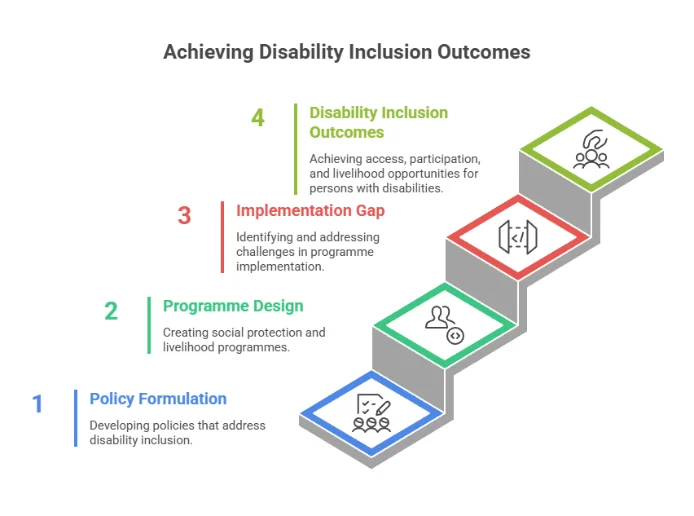
The researcher uses a conceptual framework which involves the combination of the Walt and Gilson Policy Triangle concept with Implementation Gap Analysis framework to understand how the disability inclusion policies are transformed into the real programme outcomes in social protection and livelihood programmes.
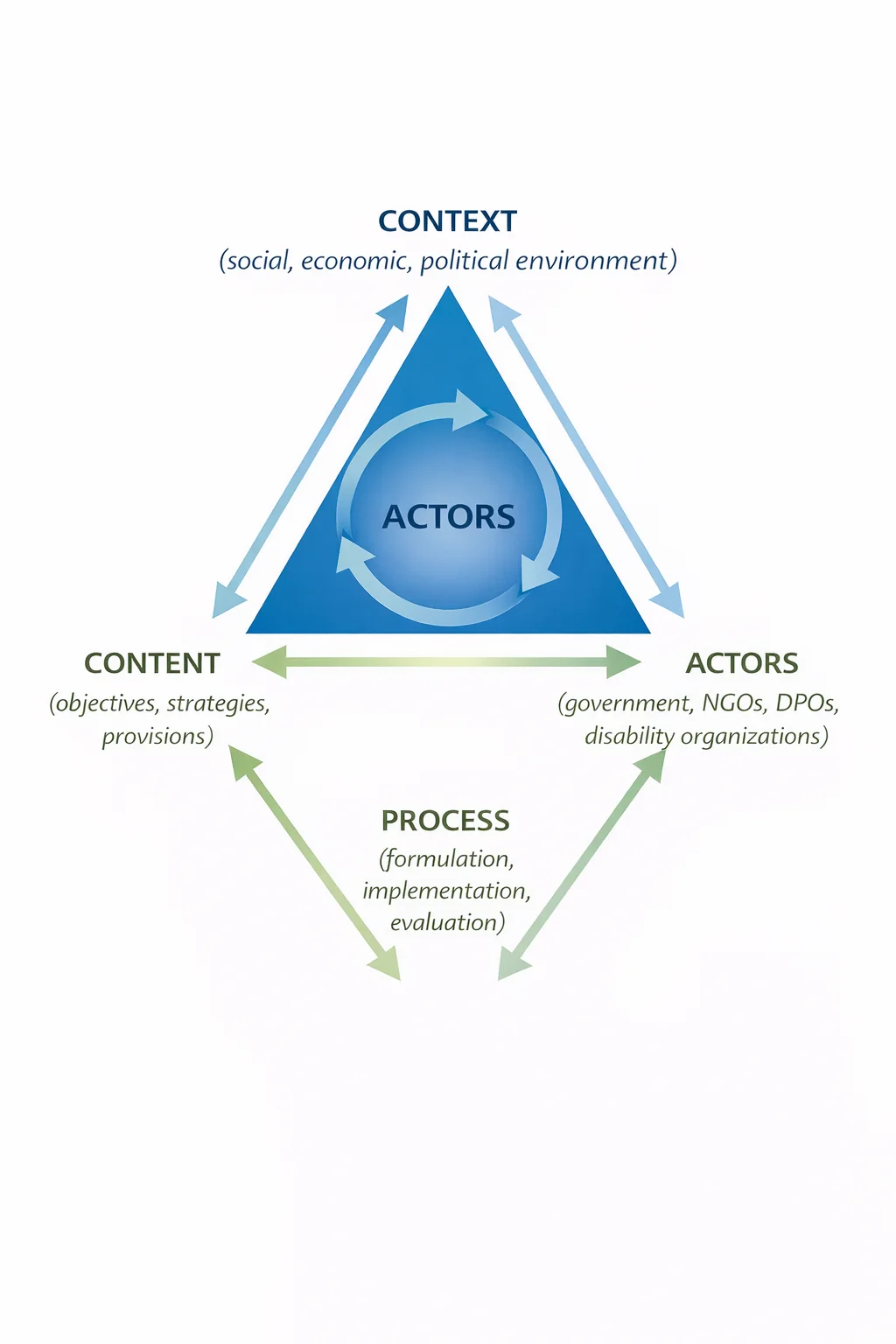
The Walt and Gilson Policy Triangle which was formulated in 1994 is commonly applied in the analysis of the processes of the public policy. The framework emphasizes four dimensions that are interrelated; these are context, content, actors, and process, which influence the process of policy formulation and the implementation of the policy. Instead of concentrating on the content of the policy only, the framework focuses on the interactions between these components in order to shape the policy results (O'Brien et al., 2020).
Policy commitments in the context of disability inclusion are usually found in national strategies of development and in the social protection systems. Nonetheless, these policies could only be successful when there are several structural and institutional conditions, such as governance capacity, allocation of resources, and involvement of stakeholders.
To overcome this problem, the study uses Implementation Gap Analysis that studies the gap between policy intentions and its actual implementation. Institutional weak points, a lack of accessibility, insufficient funding, or a lack of coordination between implementing agencies often result in implementation gaps.
Using these two methods together, the conceptual framework allows the analysis to be carried out comprehensively in the manner of how policy settings influence the provision of disability-inclusive programmes and in which areas there exist gaps between the policy promises and actual performance.
Conceptual Framework Structure
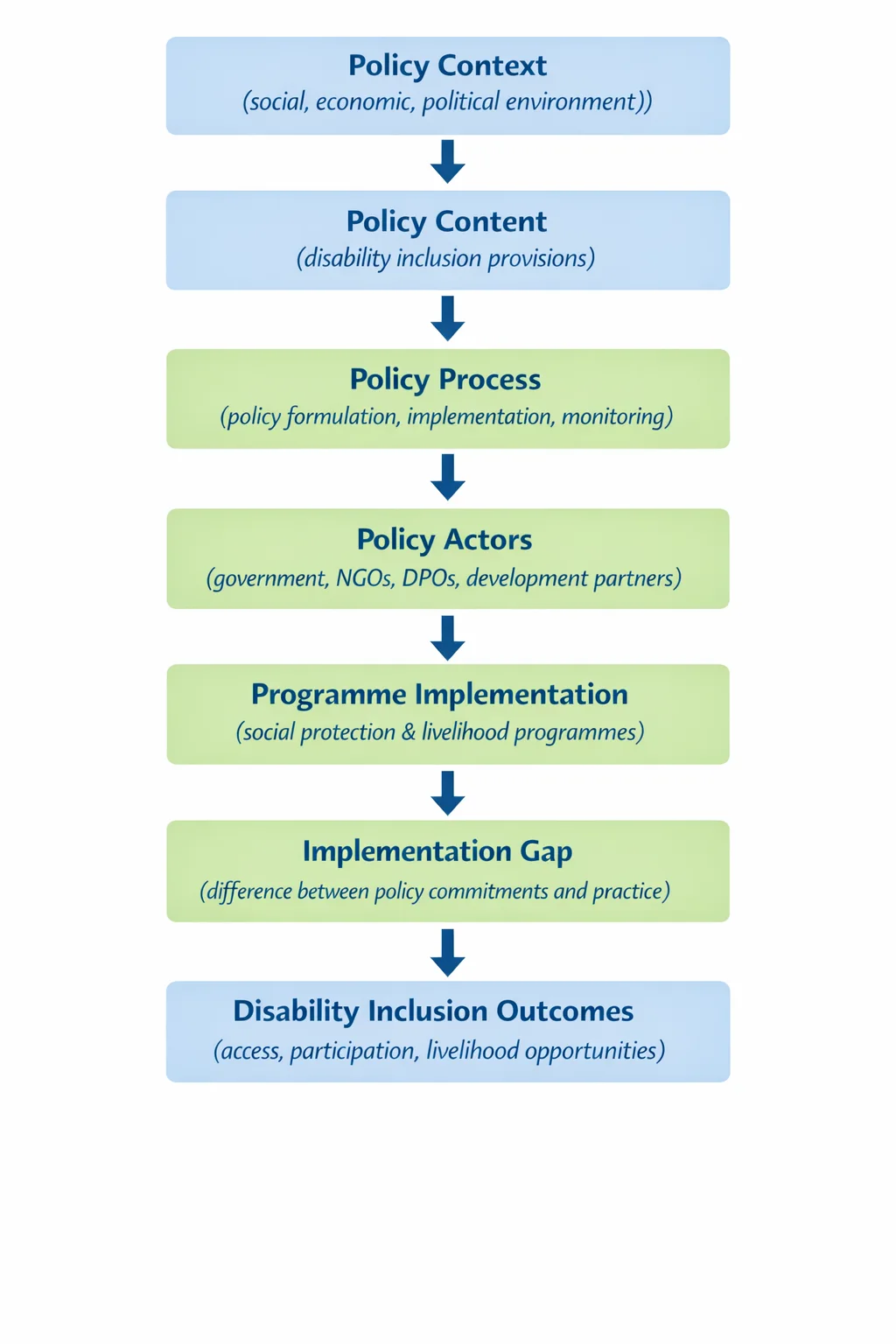
The conceptual framework is sequential relationship between the policy formulation and the programme outcomes.
1. Policy Context
The wider social, political, economic and institutional context has an effect on the way disability policies are formulated and implemented. The contextual variables are governance systems, social attitude to disability, economic ability, and development priorities.
2. Policy Content
Policy content is the official clauses of policies that strive to steer the inclusion of disability. These can be legal rights, accessibility needs, financial aids programs and inclusive livelihood strengthening systems.
3. Policy Process
Policy process entails policy formulation, implementation, monitoring and evaluation. The translation of policy goals into practice can be obstructed by weak policy processes, including lack of a good coordination mechanism or effective monitoring.
4. Policy Actors
The policy actors encompass the government, non-governmental organizations (NGOs), the disabled persons organizations (DPOs), the development partners, and the local institutions that are involved in implementing the policy. These actors have a strong power, interest, and coordination affecting the policy.
5. Programme Implementation
Interplay between policy context, content, actors and processes defines the manner in which policies are taking place in social protection and livelihood programmes.
6. Implementation Gap
Policy design and programme delivery despite the strong policy commitment, there are always differences between the design and what is actually being carried out. Such gaps in implementation can be caused by institutional hindrances, administrative inconveniences, resource deficits or a small number of persons with disabilities participation.
7. Disability Inclusion Outcomes
The last outcomes pertain to the degree of disability inclusion in the social protection and livelihood programmes in terms of access to services, programmes, and better livelihood opportunities among persons with disabilities.
Methodology
Research Design
This research design is descriptive and analytical and will be used to investigate disability inclusion policy and its gaps between the promise of the policy and the way it is implemented within the social protection and livelihood programmes.
The descriptive aspect will describe the current policies, programmes, and institutional arrangements with regard to disability inclusion. The analytical element is concerned with the analysis of the realisation of these policies in practice and determines the difference between the policy goals and programme achievements.
The research is based on a qualitative policy analysis design, which is widely adopted to analyze the content of policies, their implementation process, and institutional dynamics that shape the result of the policies of the populace.
Data Sources
The study applies secondary data sources to examine the disability inclusion policies and programme implementation. Secondary data can offer impressive information on policy regimes, institutional organization, and developmental practices on inclusion of disability
The major sources of data include:
Published academic books
Journal articles that are peer-reviewed.
Legislative systems and government policy literature.
International reports (UN agencies, development institutions, etc.)
NGO reports pertaining to disability and social inclusion.
Development agency and research reports.
Reputed newpaper
These are those sources that have detailed information on policy commitments, programme structures and implementation practices concerning inclusion of disability.
Data Collection
The data will be collected by reviewing documents and analysing secondary data. The relevant policy documents, programme guidelines, strategic plans and evaluation reports are audited in a systematic approach to detect disability inclusion provisions and implementation mechanisms.
The document review focuses on:
Disability and social protection national policies.
Marginalized groups Livelihood development programmes.
Guidelines and reports on the implementation of the programmes in institutions.
Disability inclusion assessment research and development reports.
This method will facilitate identification of policy goals, strategies of implementation and issues to do with inclusion of disability in development programmes.
Analytical Framework
The two complementary analytical methods are used in the study.
1. Policy Analysis using the Walt and Gilson Policy Triangle
The Walt and Gilson Policy Triangle framework is used to analyze policy development and implementation processes. The framework examines four key dimensions:
Context - the human social, political, and economic climate that has an impact on policy formulation.
Content - policy objectives, provisions and strategies, and disability inclusion.
Actors - stakeholders of policy making and implementation, such as government agencies, non-governmental organizations, and disability organizations.
Process- policy formulation, implementation, monitoring, and evaluation systems.
This framework helps understand how different factors interact to shape policy outcomes.
2. Implementation Gap Analysis
The difference between the policy commitments and actual programme implementation is assessed by Implementation Gap Analysis. This will look into the question of whether disability inclusion provisions are translated into practice well within the social protection and livelihood programmes.
The collected data are analyzed using qualitative analytical techniques, including:
Thematic Analysis Thematic areas concerning the inclusion of disabled people, the implementation of the policy, and the accessibility of programmes are outlined with the help of systematic coding of documents.
Policy Content Analysis The policy documents are reviewed to look into the existence of the disability inclusion provisions, programme goals and strategies of implementation.
Comparative Analysis Policy commitments are compared with actual practices in the programme to see any gaps in implementation.
Key findings are presented in tables and figures that reflect a relationship between policy commitments, mechanisms of implementation and programme outcomes.
Policy Analysis Using the Policy Triangle
Policy Context
Policy context refers to the sociopolitical, economic, and institutional factors that shape how disabilityinclusive policies are developed and prioritized.
Political commitment: Although disability rights are represented legally in the national laws and systems, the application of inclusion as a social protection has limited scope. The policymakers in Bangladesh have recognized the importance of inclusive social protection frameworks particularly in situations of disaster and climate response, which implies the increase in political awareness(Sajib, 2025).
Economic conditions: The issue of resource constraints is also important in terms of policy design and implementation. The low-budget grants set aside to include disability cut down the option of programmes to offer focused support(Manjur-e-Alam, 2021).
Social attitudes: Negativism of the society, inadequacy of the disability awareness and the ineffective disability disaggregated data systems deterrent planning and priority of inclusive policy(Nasim & Wiegers, 2025).
Institutional capacity: There is a lack of institutional coordination and a poor level of consistency in the policy inclusion of disability in sectoral policies, and operational mandates of focal units in the ministries.
These contextual factors influence both the design and delivery of disabilityinclusive programmes, creating structural challenges prior to implementation.
Policy Content
Policy content analysis explores the content of the policies, that is, what is meant in the policies, particularly how disability is integrated into the policies.
Key dimensions to review include:
Disability inclusion provisions: National legislation, including Rights and Protection of Persons with Disabilities Act, formally commits to including disabled persons, but does not specify the details of the operationalization, indicators, and accountability(NDDF, 2017).
Accessibility: It is common in the policies to talk of accessibility (e.g., universal design guidelines), yet in practice, the programme accessibility has not been made consistent (via retrofitting of public infrastructure), or even the retrofitting of old infrastructure.
Financial support: There are social protection plans (e.g., disability allowance and education vouchers) which are not strongly covered (only about 38 of persons with disabilities say they received such support at some point in short term recall studies) (Alam et al., 2023).
Livelihood opportunities: In spite of livelihood support being a policy goal, programmes do not always have direct mechanisms to support participation, skills training adaptation, or market connection of persons with disabilities(Bank, 2021).
On the whole, although the policy texts are articulating of inclusive aspirations, most of them are not operational, do not contain monitoring metrics or standards that are enforceable to guarantee any meaningful results.
Policy Actors
All policy actors need to be considered as stakeholders in the formulation and implementation of policy; roles and capacity of the policy actors are important.
Government ministries: There are various ministries that manage social protection programmes, but there is a lack of inter ministerial coordination on disability inclusion.
Nongovernmental organizations (NGOs): NGOs have been significant in the delivery of programmes, advocacy, and piloting of inclusive programmes, particularly in such areas like skills development, and disability targeted livelihood support.
Disabled People’s Organizations (DPOs): The DPOs are also important players in advocacy. They have the ability to offer lived experience skills and demand meaningful inclusion, but their involvement in the institutional policy-making processes is often symbolic, not institutional.
International development partners: Donor agencies and global disability inclusion efforts affect the agenda setting and may provide technical resources but fit with the systems of countries is still not even.
These actors need to work together in order to have a well-structured policy process but fragmentation and poor accountability have continued to restrain inclusive practices.
Policy Process
Policy process involves formulation, adoption, implementation and monitoring, all of which have possibilities of a gap.
Formulation: The policy language is frequently written in an inclusive way, and operational guidelines and resource commitment are not finalized.
Adoption: Policies are officially adopted (e.g. social protection systems) which does not mean that there are effective implementation or monitoring mechanisms.
Implementation: The implementation process often fails because of poor coordination, lack of training of implementers and data on disability to target beneficiaries.
Monitoring: Monitoring systems usually do not use disabilitydisaggregated indicators or accessible feedback mechanisms to assess progress in inclusion outcomes.
Such gaps in the processes make policy goals and real world outcomes inconsistent.
Implementation Gap Analysis
This section will compare the policy commitments and the actual practice of the programme to determine where and how gaps exist.
Policy Commitment
Intended Outcome
Actual Practice
Implementation Gap
Inclusive livelihood training
Equal participation
Limited disabled participants
Accessibility & targeting gap
Social protection coverage
Financial support
Low enrolment of persons with disabilities
Awareness & coverage gap
Accessible programme infrastructure
Physical access
Many facilities remain inaccessible
Infrastructure & enforcement gap
Explanation of gaps:
Accessibility & targeting gap: Accessibility Accessibility and targeting Programmes are formally available, yet physical, informational and systemic barriers (e.g. unreachable training facilities, unadapted training materials) are barriers to participation.
Awareness & coverage gap: Since only some 38 percent of persons with disabilities are indicating that they do receive social protection, there is a substantial coverage divide between the provisions of the translating programmes and their participation.
Infrastructure & enforcement gap: Accessibility standards often exist in policy but are not enforced or integrated into programme planning, resulting in inaccessible services and facilities.
All these implementation gaps are as a result of a conglomeration of the poor coordination, inadequate resources, inadequate accountability mechanisms, as well as poor participation of the disability organizations in implementing decisions.
The secondary data analysis shows that there is inconsistency in terms of the scope of coverage of the persons with disabilities (PwDs) within the national social protection schemes. There was a significant variance in coverage when it came to the programmes of different kinds.
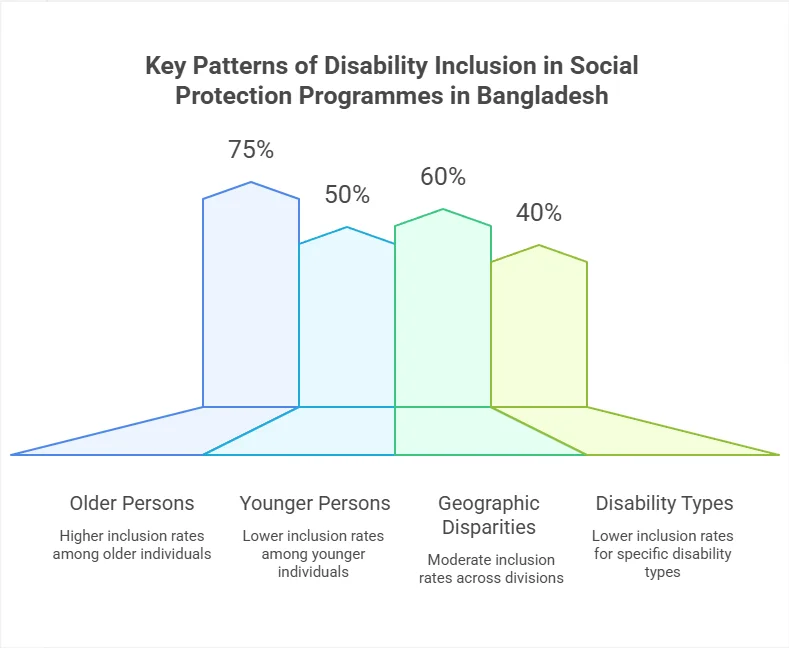
Patterns of Inclusion Across Population Subgroups
Subgroup analysis reveals differences in inclusion based on demographic variables. For example:
The inclusion of older people with disabilities was higher compared to that of the younger people.
Geographic differences were realized with inclusion rates not being similar across divisions.
There were also differences between the types of disability.
Figure 8.2 illustrates these subgroup differences.
Participation in Livelihood Programmes
The level of participation in livelihood programmes that aim at enhancing economic opportunities of PwDs was usually low. Table 8.2 outlines participation rates in reports and evaluations of the programmes.
Participation Measure
Rate (%)
Registered participants with disabilities
15.0
Successful completion of training
10.4
Access to posttraining support
7.2
Implementation Barriers Identified
Document and policy reviews identified recurring categories of barriers that constrain the practical implementation of disabilityinclusive policies.
Table 8.3: Identified Implementation Barriers
Barrier Category
Evidence Source
Accessibility barriers
Government and NGO reports
Awareness & outreach gaps
National evaluations
Institutional coordination limits
Policy analyses and development reports
Monitoring and data limitations
International agency evaluations
Summary of Policy–Practice Gaps
To quantify differences between disabilityinclusive commitments in policy and observed implementation outcomes, an implementation gap summary was constructed.
Table 8.4: Policy Commitment vs Observed Implementation Outcomes
Policy Commitment
Intended Outcome
Observed Practice
Implementation Gap
Inclusive livelihood training
Equitable participation
~15 % participation rate
Accessibility & outreach gap
Expanded social protection coverage
Financial support
~38 % inclusion within six months
Coverage & targeting gap
Accessibility standards enforcement
Accessible programme access
Many facilities and materials remain inaccessible
Infrastructure & implementation gap
Disability data monitoring
Disaggregated outcome data
Weak or inconsistent tracking
Data & accountability gap
Discussion
The findings of this research indicate that there are a lot of shortcomings between policy promises of disability inclusion and programme delivery in social protection and livelihood programmes. The gaps can be oriented to the larger tendencies in disability inclusion research, which highlight continuous structural and governance issues that hinder meaningful inclusion.
Linking Findings with Previous Research
This paper, as well as the research in the world, established that formal policy commitments are rarely executed to their fullest extent. The former syntheses of disability-inclusive social protection observe that although disability-sensitive frameworks, such as cash transfers and disability-related benefits, may be found in most low-income settings, lack of data, and excessive monitoring costs, low awareness, and absence of adequate budgets remain common. Such limitations prevent the performance of the programme and fair access of persons with disabilities(Rohwerder, 2013).
The pattern observed, with disability allowances demonstrating greater coverage than other social support schemes, is similar to a host of country contexts which have shown that specific schemes can get to more people than larger programmes which do not have the developed implementation strategies. The level of disability inclusion in livelihood programmes is still very low implying that economic empowerment goals are yet to be operationalised appropriately. These results are correlated with more general studies that have indicated that the efforts to include disability in its efforts are often hindered by implementation factors, even in the context of established policy frameworks (Grech et al., 2023).
Policy Theories and Implementation Gaps
Viewed through the prism of policy process, the Walt and Gilson Policy Triangle demonstrates how the policy outcomes can be the product of interplay between context, content, actors, and process not only the presence of inclusive provisions. The identified gaps in implementation in this study demonstrate a poor fitment in these areas, especially, in the case of governance mechanisms and the engagement of actors. The presence of political commitment (e.g. ratification of the UN Convention on the Rights of Persons with Disabilities - UNCRPD - and domestic legislation) has been demonstrated, although structural factors like institutional capacity, organizational actions and social attitudes restrain successful policy translation. According to the implementation literature, rights-based policies such as the CRPD are subject to sound governance arrangements - such as accountability mechanisms, data systems that are disability disaggregated and multi stakeholder engagement are needed to make a real-world impact (United Nations, 2025a).
It is not just the existence of policy content. Unless Disabled People's Organisations (DPOs) take an active role, persons with disabilities are truly engaged in the process of decision-making, and resources are continually provided, the process of policy making may turn into a sham. These gaps are representative of the general critique of policy theory: that institutional structures tend to consider technocratic design more important than process-involvement that promotes lived experience and community knowledge in execution (Cabinet Division (GED), 2024).
International Frameworks on Disability Inclusion
Normative standards of disability inclusion are presented at an international level by the UNCRPD and the 2030 Agenda of Sustainable Development. The CRPD focuses on the right of persons with disabilities to full inclusion, equality, and nondiscrimination and combats legal and practical barriers to rights in every aspect of life such as justice, education, employment and accessibility.
However, world experience demonstrates one common problem of implementation: although the CRPD poses high normative aspirations, it provides much freedom to States in terms of what specific measures and mechanisms would be necessary to achieve these aspirations. The national efforts can be plagued by a lack of operationalisation and enforceable standards such that, despite adopting CRPD language, they commit less resources to implementation, monitoring and accountability, which can as well be seen in the results of this study.
Structural Barriers to Disability Inclusion
The results underscore a range of structural barriers that impede effective disability inclusion in social protection and livelihood programmes. These include:
Accessibility barriers: Infrastructure and service environments often remain physically or digitally inaccessible for persons with sensory, mobility, or cognitive impairments, limiting their participation(Era et al., 2026).
Awareness and targeting issues: Limited outreach and disability awareness among programme staff and communities contribute to low enrolment and participation of persons with disabilities.
Data gaps: Weak disabilitydisaggregated data systems constrain effective targeting, monitoring, and evaluation of inclusion outcomes — a challenge highlighted in both international and national reports(SSPS, 2025).
These structural barriers reflect broader socioeconomic intersecting factors such as poverty, marginalisation, and limited access to education and employment, which intensify exclusion for persons with disabilities, particularly in rural and lowincome settings.
Governance Challenges
Effective governance is critical for translating policy commitments into outcomes. However, this study’s findings indicate several governance weaknesses:
Fragmented coordination: Multiple agencies may share responsibility for disability inclusion without clear lead agencies or mechanisms for coordinated implementation.
Insufficient capacity: Ministries and implementing bodies often lack technical skills (e.g., sign language proficiency) and financial resources for accessible services and programming.
Limited participation: Disabled People’s Organisations and persons with lived experience are not always systematically involved in policy design, implementation, or monitoring, limiting the responsiveness of programmes to actual needs.
These governance challenges align with policy theories that emphasise the role of institutional arrangements in shaping implementation outcomes. Without strong accountability structures, inclusive monitoring indicators, and sustained political commitment, even wellarticulated disability policies may fail to yield substantive inclusion.
Synthesis
Overall, the results indicate that indeed, there are policy frameworks on disability inclusion, but, in practice, the structural and governance issues limit their implementation. These impediments are not specific to Bangladesh, these are general trends of the Global South environment, where poverty, disjointed institutions and lack of capacity are overlapped to curtail the realisation of disability rights models like the CRPD.
To overcome these challenges, working towards enhancement of governance mechanism, increasing accessibility and awareness, incorporating disability data system, and significant inclusion of persons with disabilities and advocacy organisations in all policy implementation processes are critical.
Policy Recommendation
To enhance disability inclusion in social protection and livelihood programmes, policies must be converted into operationally clear, inclusive designs that have measurable objectives, accessibility standards that are enforceable and meaningful participation mechanisms of the persons with disabilities and their representative organisations in policy making and monitoring which are in line with the national strategies and the international commitments towards inclusive development.
Conclusion
Though there is an increasing policy focus on disability inclusion, which is evident in national frameworks, international commitments like the UN Convention on the Rights of Persons with Disabilities (UNCRPD), and recent national discussions on the topic of inclusive social protection, this research paper finds that there are still significant policy gaps in the areas of operationalisation, accessibility, data systems, and governance limiting meaningful inclusion of persons with disabilities in social protection and livelihood programmes. Practically, clear policies tend to miss procedural clarity, strong monitoring, and enforceable standards and thus cover the limited scope and participation also lack structural implementation and disenfranchise many of those, who are meant to receive any benefits. This policy-practice gap needs to be closed to transform the official promises into actual services, enhance fair access to them, and support the rights of people with disabilities as citizens but not beneficiaries. The strategies to be taken forward in the implementation of inclusive policies must focus on enhancing institutional capacity, development of integrated monitoring systems with disability disaggregated data, accessibility standards, and active involvement of persons with disabilities and their representative organisations in the design, implementation, and evaluation of the programmes to transform the aspirational policies to responsible and effective practice.
Reference
Alam, B., Abu, M., Rony, T., Islam, A., Hasan, K., Khan, K. K., & Khan, K. K. (2023). Exploring Access to Social Protection for People with Disabilities in Bangladesh. International Journal of Clinical Surgery, 2(6). https://doi.org/10.31579/2834
Bank, W. (2021). POLICY RECOMMENDATIONS ON ACCELERATING INCLUSIVE EMPLOYMENT OF PERSONS WITH DISABILITIES IN BANGLADESH. www.worldbank.org
Banks, L. M., Kuper, H., & Polack, S. (2017). Poverty and disability in low-And middleincome countries: A systematic review. In PLoS ONE (Vol. 12, Number 12). Public Library of Science. https://doi.org/10.1371/journal.pone.0189996
Banks, L. M., Walsham, M., Neupane, S., Neupane, S., Pradhananga, Y., Maharjan, M., Blanchet, K., & Kuper, H. (2019). Access to Social Protection Among People with Disabilities: Mixed Methods Research from Tanahun, Nepal. European Journal of Development Research, 31(4), 929–956. https://doi.org/10.1057/s41287-019-0194-3
Barnes, C., & Mercer, G. (2005). Disability, work, and welfare: Challenging the social exclusion of disabled people. In Work, Employment and Society (Vol. 19, Number 3, pp. 527–545). SAGE Publications Ltd. https://doi.org/10.1177/0950017005055669
Barua, L. (2018). Socio-Economic Implications of Disability- Inclusive Education: Global and Local Views.
Brolan, C. (2016). A Word of Caution: Human Rights, Disability, and Implementation of the Post-2015 Sustainable Development Goals. Laws, 5(2), 22. https://doi.org/10.3390/laws5020022
Devandas Aguilar, C. (2017). Social protection and persons with disabilities. In International Social Security Review (Vol. 70). www.un.org/development/desa/disabilities/convention-on-the-rights-of-persons-with-
Diedrich, A., Duce, S., Eriksson, H., Govan, H., Harohau, D., Koczberski, G., Lau, J., Mills, D., Minter, T., Steenbergen, D., & Troell, M. (2022). An applied research agenda for navigating diverse livelihood challenges in rural coastal communities in the tropics. In One Earth (Vol. 5, Number 11, pp. 1205–1215). Cell Press. https://doi.org/10.1016/j.oneear.2022.10.005
Era, S. I., Ime, I. T., & Islam, A. B. M. A. Al. (2026). Evaluating Web Accessibility and Usability in Bangladesh: A Comparative Analysis of Government and Non-Government Websites. Cornel University. http://arxiv.org/abs/2601.00592
Ganshanga, A., & Twinamasiko, S. (2025). ‘Bridging the Gap’: Integrating Human Rights-Based Approaches to Disability Welfare in Local Government in Uganda. Scandinavian Journal of Disability Research, 27(1), 714–727. https://doi.org/10.16993/sjdr.1286
Gréaux, M., Moro, M. F., Kamenov, K., Russell, A. M., Barrett, D., & Cieza, A. (2023). Health equity for persons with disabilities: a global scoping review on barriers and interventions in healthcare services. In International Journal for Equity in Health (Vol. 22, Number 1). BioMed Central Ltd. https://doi.org/10.1186/s12939-023-02035-w
Hunt, X., Saran, A., Banks, L. M., White, H., & Kuper, H. (2022). Effectiveness of interventions for improving livelihood outcomes for people with disabilities in low- and middle-income countries: A systematic review. In Campbell Systematic Reviews (Vol. 18, Number 3). John Wiley and Sons Inc. https://doi.org/10.1002/cl2.1257
International Disability Alliance. (2019). Participation of Organisations of Persons with Disabilities in Development Programmes and Policies.
Manjur-e-Alam, S. (2021, February 11). Development process not inclusive for people with disabilities; TIB makes 14-point recommendations to control irregularities and corruption and establish good governance. Transparency International Bangladesh. https://www.ti-bangladesh.org/index.php/en/articles/press-release/6253?utm_source=chatgpt.com
Meeks, L. M., Maraki, I., Singh, S., & Curry, R. H. (2020). Global commitments to disability inclusion in health professions. The Lancet, 395(10227), 852–853. https://doi.org/10.1016/S0140-6736(20)30215-4
Mitra, S., Posarac, A., & Vick, B. (2013). Disability and Poverty in Developing Countries: A Multidimensional Study. World Development, 41(1), 1–18. https://doi.org/10.1016/j.worlddev.2012.05.024
Nasim, R., & Wiegers, O. (2025). Scoping Opportunities for Disability-Inclusive Disaster Risk Reduction, Humanitarian Action, and Climate Action in Bangladesh.
NDDF. (2017). Vision and Mission | Page | National Disability Development Foundation. National Disability Development Foundation. https://jpuf.gov.bd/pages/static-pages/6922dc9a933eb65569e11367
Niane, I., Aning, A., Zaaba, Z., & Gunggut, H. (2014). IMPLEMENTATION GAP: REFERENCE TO A POLICY FOR PERSONS WITH DISABILITIES. Journal of Administrative Science, 11.
Norton, A., Conway, T., & Foster, M. (2002). Social Protection: Defining the Field of Action and Policy. In Development Policy Review (Vol. 20, Number 5). Overseas Development Institute.
Omari, S. K., & Mosses, L. I. (2025). Assessing the implementation gap of disability inclusive health in Tanzania’s universal health insurance act. In Discover public health (Vol. 22, Number 1). BioMed Central Ltd. https://doi.org/10.1186/s12982-025-01187-0
Pal, G. C. (2018). Disability, Social Policy and Inclusiveness: The Missing Links. Journal of Social Inclusion Studies, 4(2), 301–324. https://doi.org/10.1177/2394481118817960
Palmer, M. (2011). Disability and poverty: A conceptual review. In Journal of Disability Policy Studies (Vol. 21, Number 4, pp. 210–218). https://doi.org/10.1177/1044207310389333
Pinilla-Roncancio, M. (2015). Disability and poverty: Two related conditions. A review of the literature. Revista Facultad de Medicina, 63(3), S113–S123. https://doi.org/10.15446/revfacmed.v63n3sup.50132
Pinilla-Roncancio, M., Mactaggart, I., Kuper, H., Dionicio, C., Naber, J., Murthy, G. V. S., & Polack, S. (2020). Multidimensional poverty and disability: A case control study in India, Cameroon, and Guatemala. In SSM - Population Health (Vol. 11). Elsevier Ltd. https://doi.org/10.1016/j.ssmph.2020.100591
Rahman, M., Rana, M. S., Rahman, M. M., & Khan, M. N. (2025). Exploring access to social protection by persons with disabilities in Bangladesh. PLoS ONE, 20(4 April). https://doi.org/10.1371/journal.pone.0321887
Razzaque, M., & Hasan, E. (2024). Persons with Disabilities in Bangladesh: Addressing Gaps in Data, Social Protection and Employment Accessibility.
Rohwerder, B. (2013). Disability Inclusion in Social Protection - Institute of Development Studies. GSDRC. https://www.ids.ac.uk/publications/disability-inclusion-in-social-protection/?utm_source=chatgpt.com
Sajib, K. A. (2025, December 23). National dialogue calls for disability-inclusive social protection in disaster, climate response. Dhaka Tribune. https://www.dhakatribune.com/bangladesh/399399/national-dialogue-calls-for-disability-inclusive
Siregar, H., Suriadi, A., & Amal, B. K. (2025). Enhancing disability satisfaction through vocational training and inclusive programs: Evidence from pls-sem modeling. Research Journal in Advanced Humanities, 6(2). https://doi.org/10.58256/wf8x8394
SSPS. (2025, May 16). UNDP and NIMC Join Forces to Promote Disability Inclusion Through Media | Social Security Policy Support (SSPS) Programme. Social Security Policy Support (SSPS) Programme. https://socialprotection.gov.bd/2025/05/undp-and-nimc-join-forces-to-promote-disability-inclusion-through-media/?utm_source=chatgpt.com
Steinert, C., Steinert, T., Flammer, E., & Jaeger, S. (2016). Impact of the UN convention on the rights of persons with disabilities (UN-CRPD) on mental health care research - a systematic review. BMC Psychiatry, 16(1). https://doi.org/10.1186/s12888-016-0862-1
The Lancet Regional Health – Southeast Asia. (2025). Inclusivity for people living with disability: the gap between understanding and implementing. In The Lancet Regional Health - Southeast Asia (Vol. 37). Elsevier Ltd. https://doi.org/10.1016/j.lansea.2025.100614
United Nations. (2006). Convention on the Rights of Persons with Disabilities.
United Nations. (2018). World social report: Persons with disabilities—Breaking down barriers.
United Nations. (2025). Global disability inclusion report: Accelerating disability inclusion in a diverse and changing world.
Wood, G. (2006). How can we achieve disability inclusion? | Office of Strategy and Evidence Innocenti. https://www.unicef.org/innocenti/how-can-we-achieve-disability-inclusion
World Bank. (2007). Social Analysis and Disability: A Guidance Note Incorporating Disability-Inclusive Development into Bank-Supported Projects.
World Health Organization, & World Bank. (2011). World report on disability. World Health Organization.
Figure 1.Disability inclusion policy flowchartFigure 2.Policy analysis triangle: context, content, process and actorsFigure 3.Disability Inclusion Policy Implementation FrameworkFigure 8.1.Social Protection Coverage by Programme TypeFigure 8.2.Key patterns of disability inclusion in social protection programmes in Bangladesh
CITE THIS ARTICLE
Anika, J. (2026). From Policy to Practice: Disability Inclusion Gaps in Social Protection and Livelihood Programmes. https://www.researchbyjeba.com/article/6a57d35b-b018-4d56-a829-427eca7b087a
J. Anika, “From Policy to Practice: Disability Inclusion Gaps in Social Protection and Livelihood Programmes,” 2026. [Online]. Available: https://www.researchbyjeba.com/article/6a57d35b-b018-4d56-a829-427eca7b087a
Anika, J. (2026) ‘From Policy to Practice: Disability Inclusion Gaps in Social Protection and Livelihood Programmes’. Available at: https://www.researchbyjeba.com/article/6a57d35b-b018-4d56-a829-427eca7b087a
Anika, Jeba. “From Policy to Practice: Disability Inclusion Gaps in Social Protection and Livelihood Programmes.” 2026, https://www.researchbyjeba.com/article/6a57d35b-b018-4d56-a829-427eca7b087a.
Jeba Anika. “From Policy to Practice: Disability Inclusion Gaps in Social Protection and Livelihood Programmes.” (2026). https://www.researchbyjeba.com/article/6a57d35b-b018-4d56-a829-427eca7b087a.
Anika J. From Policy to Practice: Disability Inclusion Gaps in Social Protection and Livelihood Programmes. 2026. https://www.researchbyjeba.com/article/6a57d35b-b018-4d56-a829-427eca7b087a
@misc{article_6a57d35bb0184d56a829427eca7b087a,
  title = {From Policy to Practice: Disability Inclusion Gaps in Social Protection and Livelihood Programmes},
  author = {Jeba Anika},
  year = {2026},
  url = {https://www.researchbyjeba.com/article/6a57d35b-b018-4d56-a829-427eca7b087a},
}
TY  - GEN
AU  - Jeba Anika
TI  - From Policy to Practice: Disability Inclusion Gaps in Social Protection and Livelihood Programmes
PY  - 2026
UR  - https://www.researchbyjeba.com/article/6a57d35b-b018-4d56-a829-427eca7b087a
ER  -
This study investigates the intersection of household power dynamics, social stigma, and women's autonomy in reproductive health decision-making, focusing on Bangladesh. It explores how these factors influence women’s access to reproductive health services and their ability to make informed reproductive choices. Using a mixed-methods design, the study combines quantitative surveys and qualitative interviews to examine the role of household decision-making power, social norms, and reproductive co
The situation in Bangladesh is such that healthcare disparities are influenced by structural, economic, and social factors and result in unequal health status, especially among the marginalized groups. Although there have been some positive changes in the public health, like the increase in life expectancy and the reduction in the child mortality, the disparity is still high. The major obstacles are the high out-of-pocket (OOP) expenditure that burdens low income households financially and the g